Salt has anchored spiritual practice across virtually every human culture for thousands of years. From Roman soldiers receiving wages in salt to Shinto priests purifying sumo rings before matches, this mineral carries a weight that goes far beyond the kitchen. Understanding which types of salt to use for spiritual purposes, and why, can genuinely transform your practice.
Why Salt Holds Spiritual Power
Salt’s preservation properties made it sacred long before modern spirituality gave it metaphysical labels. As the Ilanga Nature editorial team notes, “its incorruptibility makes it a powerful symbol of purity and eternity across many cultures.” That physical reality, the ability to resist decay and repel bacteria, maps directly onto its spiritual function: resisting corruption, repelling negativity, and maintaining energetic integrity.
Chemically, salt releases negative ions when dissolved in water, which many practitioners believe contributes to its cleansing energetic signature. Whether you approach this scientifically or symbolically, the result is consistent across traditions.
The Most Important Salt Types and Their Spiritual Properties
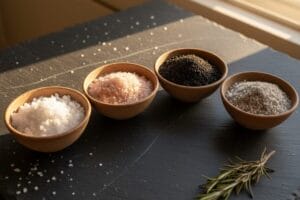
Different salts carry distinct mineral compositions, origins, and energetic signatures. Choosing the right one matters.
Sea Salt: The workhorse of spiritual practice. Harvested directly from ocean water, it retains trace minerals that practitioners associate with broad-spectrum purification. Use it for cleansing objects, casting circles, and floor washes. A Reddit practitioner from r/pagan puts it plainly: “Plain white salt is usually used as a purification element, or to cast a circle. Sometimes used as a protection element, which is generally handy.”
Himalayan Pink Salt: Gets its distinctive color from iron oxide and over 80 trace minerals. Spiritually, it’s linked to heart chakra work, emotional healing, and energetic balance. Its warm, nurturing energy makes it well-suited for self-care rituals, salt lamps, and love-drawing work.
Witches Black Salt: Perhaps the most misunderstood variety. Commercially sold black salt is typically food-grade salt colored with activated charcoal or squid ink. Traditional witches black salt is made by combining sea salt with cauldron scrapings, ash from burned protective herbs, and iron filings. The Quora practitioner community consistently confirms: “Black salt is generally used for protection, banishing, and guarding against spiritual attacks.” Use it at thresholds, in banishing jars, or sprinkled across doorways to block unwanted energy.
Celtic Grey Salt (Sel Gris): Harvested from clay-lined salt pans in France, giving it a grey hue and high mineral density. Its grounding, earthy energy suits ancestral work and root chakra rituals.
Himalayan Black Salt (Kala Namak): A sulfur-rich volcanic salt from South Asia that carries Mars energy. It’s used in transformation rituals and breaking stagnant patterns, making it very different from witches black salt despite the similar name.
Dead Sea Salt: Contains exceptionally high magnesium and bromide concentrations. It excels in deep purification baths, particularly after energetically draining experiences or psychic protection work.
Red Alaea Salt: From Hawaii, this salt carries iron-rich volcanic clay. Hawaiian traditions use it in healing ceremonies, and its red color corresponds to vitality, courage, and grounding in color magic systems.
For a comprehensive overview of salt varieties organized by spiritual tradition and ritual purpose, the breakdown of 11 distinct types provides solid grounding for newer practitioners.
How to Use Salt in Spiritual Practice
The application matters as much as the salt type. Here are the core methods most practitioners rely on:
- Salt circles: Pour a continuous line around your ritual space for protection. Sea salt or black salt work best here.
- Salt baths: Dissolve Dead Sea salt or Himalayan pink salt in warm water, soak for 20 minutes, and visualize negativity draining away.
- Threshold placement: Line doorways and windowsills with black salt or sea salt to block unwanted energies from entering.
- Salt jars: Combine black salt, protective herbs like rosemary and black pepper, and a sealed intention for long-term protective spellwork.
- Altar bowls: Place a small dish of salt on your altar as a standing purification element, refreshing it monthly on the new moon.
If you’re building a ritual salt practice and want to explore curated spiritual salts matched to specific intentions, dedicated products can simplify the process considerably.
Safety and Practical Considerations
Some applications carry real risks worth knowing about before you start. Black salt, particularly the traditional witches variety containing ash and iron, should be kept away from children and pets. Salt also damages hardwood floors and certain stone surfaces if left in direct contact.
Avoid placing salt near moisture-sensitive crystals like selenite, halite, or lepidolite, as it can cause them to dissolve or deteriorate over time. Dispose of used protective salt by burying it in soil away from your home or flushing it down the drain with running water. Never reuse it in cooking or leave it sitting on your altar after it has done its work.
Consecrating Salt Before Ritual Use
Most practitioners skip this step, but consecrating your salt before use significantly sharpens its intentional focus. Hold the salt in your dominant hand, visualize white or golden light filling it, and state your intention aloud. Some traditions pass it through incense smoke or leave it under moonlight overnight.
This activation step transforms raw mineral into a purposeful ritual tool. Original Botanica’s guide to spiritual salt uses covers several traditional consecration approaches worth reviewing.
FAQ
What is the best salt for spiritual cleansing?
Sea salt is the most widely recommended for general cleansing due to its broad-spectrum purifying properties and ocean origin. For deeper energetic clearing, Dead Sea salt in a ritual bath is particularly effective.
Can I use regular table salt for spiritual purposes?
Yes, though it is the least preferred option. Table salt is heavily processed and stripped of trace minerals, which many practitioners believe reduces its energetic potency. It works in a pinch but is not ideal for serious ritual work.
How often should I replace protective salt at doorways?
Refresh threshold salt monthly, or immediately after any significant argument, illness, or unwanted visitor in your space. Clumping or discoloration can signal that the salt has absorbed heavy energy and needs replacing.


Comments